As communities around the world celebrate Pride Month, new global data reminds us that the struggle for LGBTQ+ rights is far from over.
At NEXUM Human Rights, we believe that human rights are universal and indivisible. Pride Month is an opportunity not only to celebrate diversity and inclusion, but also to reflect on the challenges that millions of LGBTQ+ people continue to face worldwide.
While significant progress has been achieved in many countries, recent developments demonstrate that equality cannot be taken for granted. Around the world, LGBTQ+ communities continue to face criminalization, discrimination, violence, and restrictions on their fundamental freedoms.
The latest data released by ILGA World for Pride Month 2026 paints a complex picture: while important advances have been made in some regions, a growing backlash against LGBTQ+ rights is emerging in others.
A Global Landscape of Unequal Rights
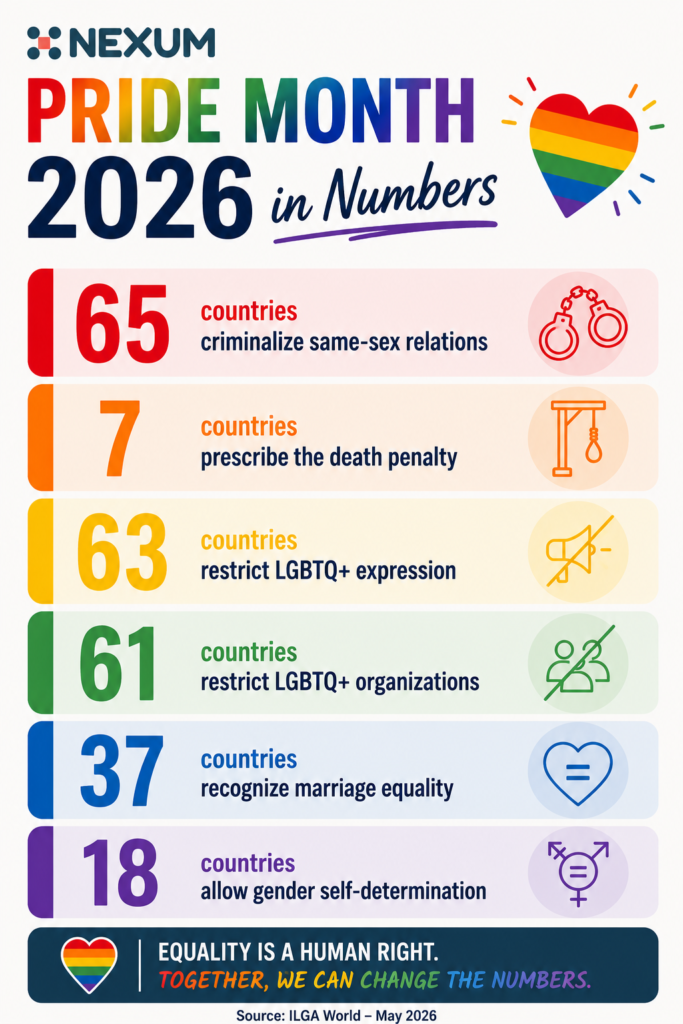
According to ILGA World, 65 United Nations member states continue to criminalize consensual same-sex sexual acts. Alarmingly, 2025 marked the first increase in the number of criminalizing countries in nearly a decade.
Even more concerning, the death penalty remains the legally prescribed punishment for consensual same-sex sexual acts in seven UN member states, while legal uncertainty regarding the possibility of capital punishment exists in five additional countries.
The data also reveals broader restrictions beyond criminalization:
- At least 63 UN member states restrict freedom of expression related to sexual orientation, gender identity, gender expression, or sex characteristics.
- At least 61 UN member states create legal barriers for LGBTQ+ organizations to register and operate.
- Only 37 UN member states and Taiwan recognize marriage equality.
- Just 18 UN member states allow legal gender recognition based on self-determination at the national level.
- Only 17 UN member states have nationwide bans on so-called conversion therapies.
- Only nine UN member states prohibit non-consensual and medically unnecessary interventions on intersex children.
These figures demonstrate that LGBTQ+ rights remain deeply uneven across the globe.
A Growing Backlash
One of the most concerning findings from ILGA World’s latest report is the rise of new restrictions targeting LGBTQ+ communities.
Since June 2025, several countries have adopted or proposed measures that limit LGBTQ+ rights and visibility. Burkina Faso criminalized consensual same-sex relations for the first time in its history, while Trinidad and Tobago reversed a previous decriminalization ruling. Senegal strengthened existing criminal laws, leading to reports of arrests and increased violence against LGBTQ+ individuals.
Other governments have introduced policies restricting discussion of sexual orientation and gender identity. Examples cited by ILGA World include censorship measures in China, website blocking in Malaysia, anti-LGBTQ legislation in Ghana, and growing restrictions in countries such as Russia, Hungary, Slovakia, Belarus, Kazakhstan, El Salvador, and the United States.
These developments reflect a broader trend in which debates about gender, sexuality, and bodily autonomy are increasingly being used as political tools by governments and anti-rights movements.
As Julia Ehrt, Executive Director of ILGA World, stated:
“More and more, authoritarian leaders and movements are trying to control what happens to our bodies and how we move through the world.”
Signs of Progress
Despite these challenges, the past year has also brought important advances.
The United Nations Human Rights Council renewed the mandate of the Independent Expert on protection against violence and discrimination based on sexual orientation and gender identity. The Council of Europe adopted its first intersex human rights standards, while the United Nations High Commissioner for Human Rights published its first report focused specifically on discrimination and violence against intersex people.
Several countries also achieved significant legal reforms:
- Saint Lucia decriminalized consensual same-sex sexual acts.
- Botswana officially removed remaining colonial-era criminal provisions.
- Cuba adopted legislation allowing legal gender marker changes without abusive requirements.
- Courts in Kenya issued landmark decisions supporting transgender rights.
- The Court of Justice of the European Union strengthened recognition of same-sex marriages across member states.
- Nepal explicitly included gender and sexual minorities within the mandate of a government ministry.
These developments demonstrate that progress remains possible when governments, courts, civil society organizations, and communities work together to advance human rights.
How Does Canada Compare?
Compared to much of the world, Canada remains among the countries with the strongest legal protections for LGBTQ+ people.
Canada recognizes same-sex marriage, protects sexual orientation, gender identity, and gender expression under federal human rights legislation, and supports LGBTQ+ inclusion through public policies and community programs.
Canada has also become an important destination for LGBTQ+ refugees fleeing persecution, violence, and criminalization in their countries of origin.
However, legal protections alone do not eliminate discrimination. LGBTQ+ people in Canada continue to experience hate crimes, barriers to healthcare, housing insecurity, and unequal treatment. These challenges often affect transgender people, Indigenous peoples, racialized communities, migrants, and refugees disproportionately.
Canada’s role therefore extends beyond maintaining legal equality at home. It also includes supporting international human rights efforts, protecting LGBTQ+ refugees, and promoting dignity and inclusion globally.
Pride as a Human Rights Commitment
Pride Month is more than a celebration of diversity.
It is a reminder that the right to live openly and safely remains out of reach for many people around the world. The latest global data demonstrates that progress is neither automatic nor guaranteed. Rights can advance, but they can also be challenged, restricted, or reversed.
For organizations committed to human rights, Pride Month offers an opportunity not only to celebrate achievements but also to reaffirm a commitment to equality, dignity, and justice for all.
At NEXUM Human Rights, we believe that every person deserves the freedom to live authentically, participate fully in society, and enjoy their rights without fear of discrimination or violence.
Because Pride is not only about visibility.
It is about human rights.
Sources
- ILGA World – Pride Month: New ILGA World Data and Maps on Laws Affecting LGBTI People Globally
- ILGA World Database
- United Nations Human Rights Council
- Office of the United Nations High Commissioner for Human Rights (OHCHR)
- Government of Canada – Federal 2SLGBTQI+ Action Plan
Published by NEXUM Human Rights in recognition of Pride Month and the ongoing global struggle for equality, dignity, and human rights for LGBTQ+ communities.